
MP033: Follows & Bate Climax
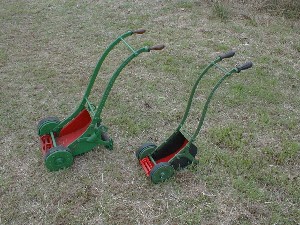
The Follows & Bate Climax was Britain's first side wheel lawn mower. Before the Climax was introduced in 1869 all lawn mowers had been driven using a combination of gears or chains that linked a rear roller with the cutting cylinder or reel. The Climax was different because the cutting cylinder was driven directly by gearing cast onto the inside of two small wheels mounted on the outside of the main chassis or side frame. As the mower was pushed forwards the gearing engaged with smaller gear wheels on the ends of the cylinder, causing it to turn at high speed to cut the grass.
This revolutionary design simplified the production of the lawn mower because there were fewer moving parts. This made side wheel mowers less expensive than their gear and chain driven counterparts. The elimination of the rear roller and heavy side frames found on traditional mowers made the side wheel much lighter and, consequently, easier to use.
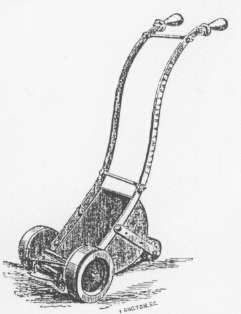
The Climax was originally available in 6, 7, 8 & 10-inch sizes. Prices in 1870 ranged from 25/- to 63/-. The first Climaxes had thin rubber tyres fitted to the outside of the wheels to provide better grip on the lawn. There is some evidence that the smallest examples of the mower only had a tyre on one of the wheels as this was the only one with the internal gearing.
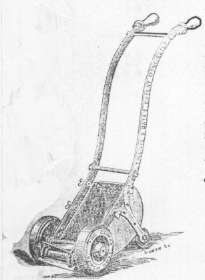
The grass was collected in a small wooden box attached to the underside of the handles and behind the cutting cylinder. The clippings were simply flicked rearwards and caught in the box. On the earliest machines the box appears to have been permanently attached and the grass was removed by hand. On later models the box could be lifted out so that the mower could be used without it and so that it could be emptied more easily.
Follows and Bate was a successful engineering company based in Gorton, Manchester. As well as a range of mowers the company also produced a number of household items and larger items down the years. The company won many prestigious medals at trade fairs and exhibitions during the Victorian era. Many of these can now be seen at the Manchester Museum of Science and Industry. Follows and Bate eventually became part of the Atco Qualcast group.
Examples of the Climax are very unusual and only a handful of examples are known to exist among collectors.