
MP042: Greens Lightweight Motor Mower
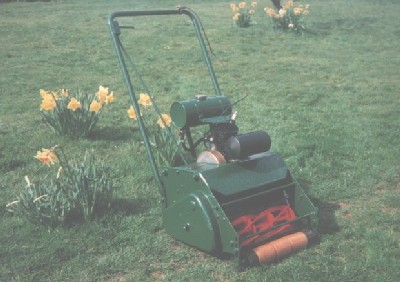
The Greens Master Lightweight Motor Mower (LMM) was a popular machine during the late 1940s and early 1950s. It was designed for use as a domestic mower on medium sized lawns. Greens claimed that the mower could cut up to quarter of an acre an hour and that "all who see this popular motor mower want it!"
The Master LMM was initially only available in 14" cutting width but a 17" version was added in 1954. The design was the last successful motor mower produced by Greens before the company became part of the Hawker Siddeley Group in 1960. The price of the mower in 1949 was £36-0-0 plus "purchase tax", a forerunner of VAT.
The design of the Master LMM was typical of many motor mowers of the period. The frame was made of plate steel for strength, low cost and ease of manufacture. The engine was the same 98cc Villiers two stroke unit that was used on so many powered machines during the 1940s and 50s. It was supported on cross members between the two side frames. Much of the engine, along with the drive shafts and clutch were hidden by a sheet steel cover that kept the operator's hands away from moving parts and added to the streamlined appearance of the mower. Safety was becoming more of a concern for manufacturers and the chains at the side of the mower were also hidden underneath a steel cover.
For simplicity there were only two controls, one to operate the throttle and one the clutch. A "kick start" mechanism allowed the mower to be started while standing in the operating position holding the handles. This arrangement had been tried in the 1930s by a few manufacturers and was the preferred method for starting a mower during the 1950s by many of the leading producers. By the end of the decade it had been superseded by the rope or pull start that is still in use today.
Another unusual design feature was the removable cutting cylinder. This aided maintenance because a blunt or damaged unit could be swapped for a new one in a few minutes and mowing could continue without waiting for a new part to be supplied. This idea was pioneered by a small number of manufacturers in the 1930s and 40s but was then forgotten as the cost of mowers decreased to the point where repairs were not cost effective. The concept was "rediscovered" in the 1990s by manufacturers who promoted designs where a number of different modules such as cutting cylinders and scarifiers could be used in the same basic mower chassis.
Thomas Green and Sons of Leeds was one of the first companies to produce motor mowers at the start of the 20th century. Its motor mower designs were never quite as popular as its hand mowers, especially its Silens Messor model. Nor were they as common as motor mowers made by its main rivals Atco and Ransomes. The Greens LMM is probably the most common of all the motorised machines made by the company. Nevertheless it is still an excellent addition to most collections.