
MP046: British Anzani Easimow & Lawnrider
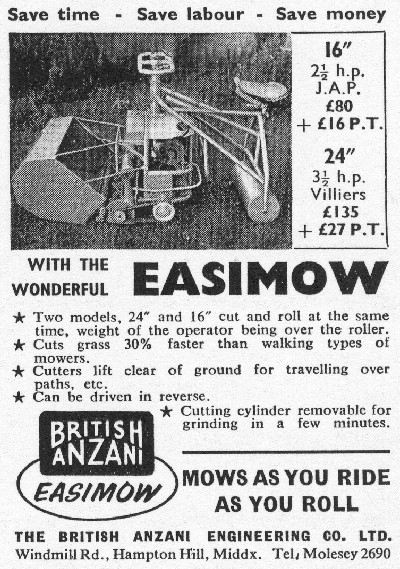
The British Anzani Easimow and its successor the Lawnrider are two of the most distinctive mowers of the past 50 years. When it was introduced in the early 1950s the Easimow was one of the first mowers specifically designed as a ride-on machine for the domestic, as opposed to professional, market.
The Easimow was originally designed and manufactured by E F Ranger (Ferring) Limited. Later that decade the manufacturing rights were acquired by British Anzani, an established and well-known manufacturer of agricultural and horticultural machinery. The company had historic links to the Anzani company that made its name manufacturing aeronautical and aircraft engines in the early years of the 20th century.
The Easimow was a very basic design. A tubular steel frame supported the engine and cutting assemblies as well as the roller seat. The mower was articulated in the middle and was steered using what might best be described as a cross between bicycle and pram handles. The early models had a 16" cut and were sold for £80 plus £16 purchase tax (a forerunner of VAT). Production was steady and, judging by the relatively few examples that are around today, the mower was not as popular as contemporary walk-behind mowers from companies such as Atco.
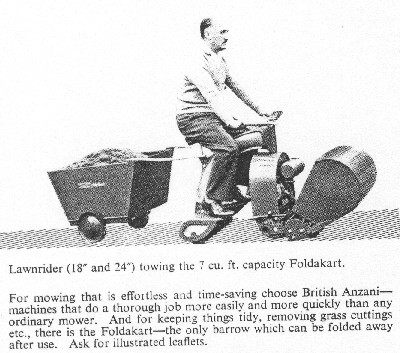
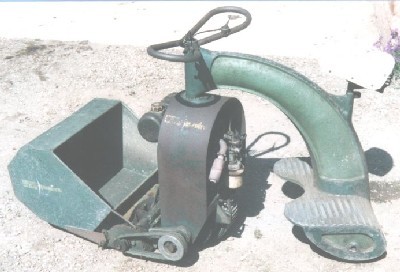
In the early 1960s the Easimow was developed into the Lawnrider. This mower, available in 18" and 24" versions, had the same basic configuration but the major difference was that the chassis was now formed from an aluminium casting. This was an unusual feature at the time and was a considerable technical achievement. The seat and rear roller (enclosed in an aluminium casting) became much more integral to the design and the mower had an appealing streamlined appearance. Some people refer to the mower as "the swan neck" because of the shape of the chassis as it rises from the rear section to the front. The Lawnrider was painted in a distinctive pale green with a metallic finish.
An unusual feature of both the Easimow and the Lawnrider is that they are basically "front-wheel drive". The power from the engine was transmitted to a drive roller on the front section of the chassis just behind the cutting cylinder. The roller of the rear chassis section supported and provided stability for the rider who sat on a bicycle seat. This layout gives the impression of a tricycle, especially on the Lawnrider where the front roller was very narrow, and can occasionally make for an interesting driving experience over uneven surfaces!
One of the innovations of the Lawnrider was that the cutting cylinder could be lifted from the lawn while the mower was in motion for easier travelling between tasks. This also enabled the Lawnrider to be used for other tasks around the garden in conjunction with attachments such as a trailer. The use of rubber belts rather than chains or gears to drive the cutting cylinder was also unusual at the time.
By the late 1960s, British Anzani was facing stiffer competition and the company stopped making the Lawnrider. The company had disappeared from the horticultural market by the early 1970s.
The Easimow and Lawnrider have a dedicated if small following among collectors. They are an interesting stage on the evolution of the lawnmower. Examples in dilapidated condition are relatively easy to find but good quality machines are more sought after.