
MP047: Qualcast Panther
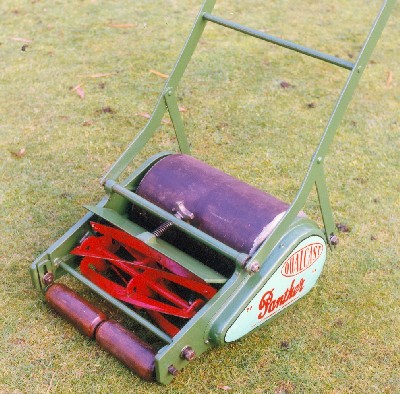
The Qualcast Panther was one of the most successful hand mowers ever made. It remained in production from 1932 until the late 1950s and over one million were sold.
The Panther was one of the first mass produced hand mowers to be manufactured from "modern" materials such as steel and components such as ball bearings. Although these are commonplace now they were unusual on mowers in the 1930s. Qualcast claimed in its trade promotion material that the Panther would "give the public a guaranteed ball bearing mower at a price lower than many sidewheel machines". Sidewheel machines were generally less expensive than roller hand mowers.
Qualcast was always successful at promoting its products. Before the Panther was available in the shops Qualcast alerted its many wholesalers and retailers that there would be an "enormous advertising campaign" to promote the new mower. Advertisements during this period focused on the quality and price of the machine and highlighted the features that were only normally found on much more expensive machines. When the Panther became one of the biggest selling mowers ever its success became an important part of the advertisements.
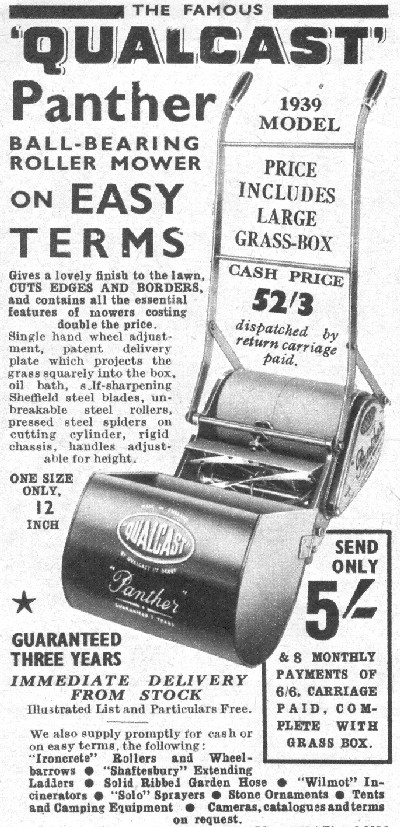
The success of the Panther is based on the simplicity of the design. Unlike the model it replaced the Panther was built using the latest materials and components. The frame was made from strong but lightweight sheet steel. A side cover protected the chain and created an oil bath for reliability and easy operation. The rear roller was manufactured from pressed steel rather than cast iron. Ball bearings ensured the roller and cutting cylinder were free running. Turning a single wheel enabled easy adjustment of the whole cutting mechanism.
The design enabled Qualcast to produce a good quality machine at a very reasonable cost, not the cheapest on the market but much less expensive than many similar machines. The original price of the Panther was £2-17-6 (approx £2.87 in modern money) and it was guaranteed for three years, which was highly unusual at the time. Customers could buy the mower in instalments over a few months. This was not a new idea but it made the mower very affordable for many people.
The Panther was only available in 12in cutting width. This is just about the optimum width for a hand mower on a normal lawn as it allows reasonably rapid mowing without making it too hard to push the mower. Smaller mowers would be easier to push but would take longer to mow the lawn whereas larger mowers would generally be quicker but required more effort.
The original Panther continued in production to the end of the 1950s. In 1959 the price of the Panther was £8-17-9 (approx £8.85) and Qualcast guaranteed it for 10 years.
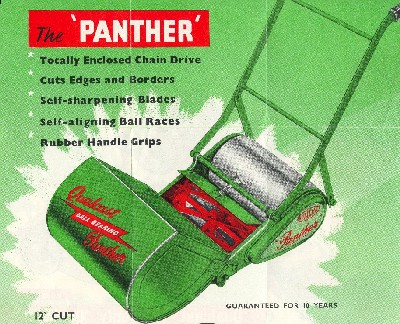
By now the original design was looking old and Qualcast introduced a new model, the Super Panther, in 1960. This was manufactured from lighter steel components. Its enclosed rear roller gave it a very streamlined appearance that was popular at the time. Newer Panther models were introduced in the 1970s and 1980s.
In fact, Qualcast still produces a model called the Panther although the modern machine is a sidewheel.
As one of the most successful mowers ever made the Qualcast Panther is not rare. Some are still in everyday use and many collectors have examples in their collections. However, it continues to hold its place as a significant part of lawn mower history.