
MP070: Early "Blue" Flymo
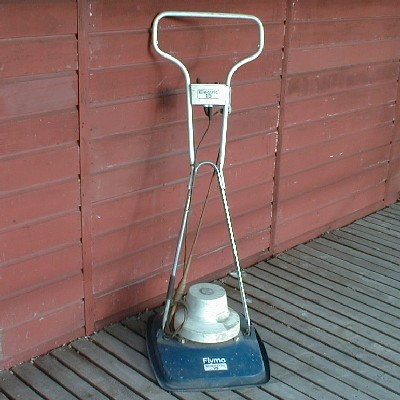
The Flymo rotary hover mower is so familiar to the modern gardener that it is hard to believe that this design classic was only invented in the 1960s.
The first Flymo mowers were made in the mid 1960s by Karl Dahlman, a Swedish inventor who took inspiration from the hovercraft that had been invented in the 1950s. Karl Dahlman won a Gold Medal at the Brussels Inventors' Fair in 1964 for his revolutionary design. It was deceptively simple. The Flymo was essentially a rotary mower with blade that had been modified to create a downward stream of air as it turned. This lifted the mower off the grass so that it floated (like a hovercraft) across the lawn. This made it very easy to push around the lawn.
This basic idea was very simple but in reality the Flymo is an extremely clever piece of engineering. The blade has to turn fast enough to generate the air stream that lifts the mower off the lawn, but not too far or the blades will be well above the grass and will not cut. And it needs to float stably above the lawn for safety and to ensure a smooth and even cut.
The first Flymo produced in 1965 was powered by a small petrol engine but in 1969 the company introduced its first electric model. These machines are surprisingly similar to the modern designs there is one major difference - they were blue and white!
The early Flymo electric mower with its 15 inch cutting width was an instant success. It was inexpensive, easy to use and produced an adequate result for most casual gardeners. It was especially popular for use on small lawns because it did a quick job and required much less maintenance than the old-fashioned sidewheel and roller mowers with which it competed. And its unique lightweight design meant that it could be hung flat against the wall of a shed or garage thereby taking up much less room than most other types of mower. The early advertising had echoes of earlier eras by implying that the Flymo was ideal for use by women (see the image below) and today would probably be considered "sexist" by many people.
It is fair to say that Flymo mowers changed the way we mow the lawn. Quite literally. Because for the first time there was a mower that did not come into contact with the turf. Instead it floated across the lawn on a cushion of air. This made it extremely easy to use. Gardeners soon began to mow their lawns by pushing and pulling the mower back and forth in a sweeping motion. Others moved the mower from side to side as they moved across the lawn and this was also a completely new way of mowing the lawn although the motion does in some ways resemble the action of using a scythe.
But there were a few drawbacks with these early electric Flymo mowers.
First, they were mains powered which meant that they could only be used as far from a socket as the lead or cord would reach. As one of the first electrical appliances for use in the garden this presented a bit of a problem if the nearest wall socket was inside the house! Today people are more used to electrical gardening tools and have special outdoor sockets. In any case the early electric Flymo was aimed at the user with the small garden. And Flymo has always produced petrol powered machines for those who prefer (or need) them.
Second, the mower was not much good at cutting long grass so gardeners still needed to get the lawn down to a workable length at the beginning of the year. This is still a bit of a drawback although modern machines can now cope with slightly longer grass.
Third, the original Flymo could not pick up the clippings. This was not a major problem if the lawn was mowed frequently and the grass was short because the cuttings simply fell back onto the lawn's surface where they were absorbed by decomposition. Later, Flymo perfected a mechanism for collecting the clippings and many of the company's modern machines have these as standard.

Flymo mowers remained blue and white until 1977 when the familiar orange colour was adopted across the range. The company became part of the Electrolux Group in 1969 and remains part of this major international organisation.
Flymo mowers of this age are right on the edge of the period that interests many collectors. Some museums already have examples on show but very few private collectors are actively seeking them at present. But they are becoming more collectable and examples in excellent and original condition are sure to be the most sought after in coming years.