
MP083: Pennsylvania Roller Mower
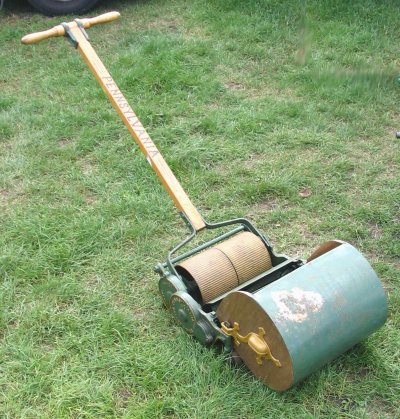
The Pennsylvania Roller Lawn Mower was manufactured in various forms during the years either side of the First World War. It was designed for mowing fine turf found on golf courses and bowling greens.
The mower was available in 10in, 12in, 14in and 16in cutting widths priced from £7-0-0 to £11-10-0 including the grass box and a choice of handle styles (1926 price list). The standard fit was the wooden T handle which is more commonly seen on side wheel mowers although conventional steel side handles used on most roller mowers were also available. Almost all known surviving examples have the wooden T handle.
The original Pennsylvania side wheel mower was introduced in the 19th century in the USA but the design was soon exported to other countries. In time, the phrase "Pennsylvania Quality" was used to designate that the mowers were superior to other models. More specifically, the term referred to the quality of the steel used for the blades (in much the same way that Sheffield steel was recognised in the UK).
Lloyds of Letchworth originally resold Pennsylvania sidewheel mowers imported from the USA but soon started making their own versions under licence. By the 1920s the company was producing a number of different mowers with the Pennsylvania brand name, including the roller mower, various side wheels, trimmers, gang mowers and even lawn sweepers. In its 1926 catalogue the company stated that the Pennsylvania roller lawn mower was ideal for surfaces where "an extremely close, smooth cut, combined with a Billiard Table finish is essential".
The Pennsylvania Roller Lawn Mower was one of the first designs to feature precision gear drives. The gears on all early mowers were generally made from cast iron which did not lend itself to precision mechanisms although the design and engineering of such machines did progress somewhat from the 1830s to the 1900s. But it was only when high grade machine steels became widely available and inexpensive that they were used on utility machines like lawn mowers. To an extent the skills and materials developed during the First World War were transferred to manufacturing peace-time machinery in the 1920s. This explains partly why so many manufacturers were innovating with lawn mower design during the decade immediately after the Armistice.
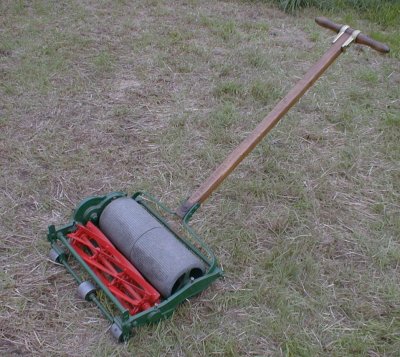
The Pennsylvania roller mower is much less common than the side wheel mower with the same name.